WSP-007 · Crossing
Santa Muerte
What must cross, measured against where you actually stand.
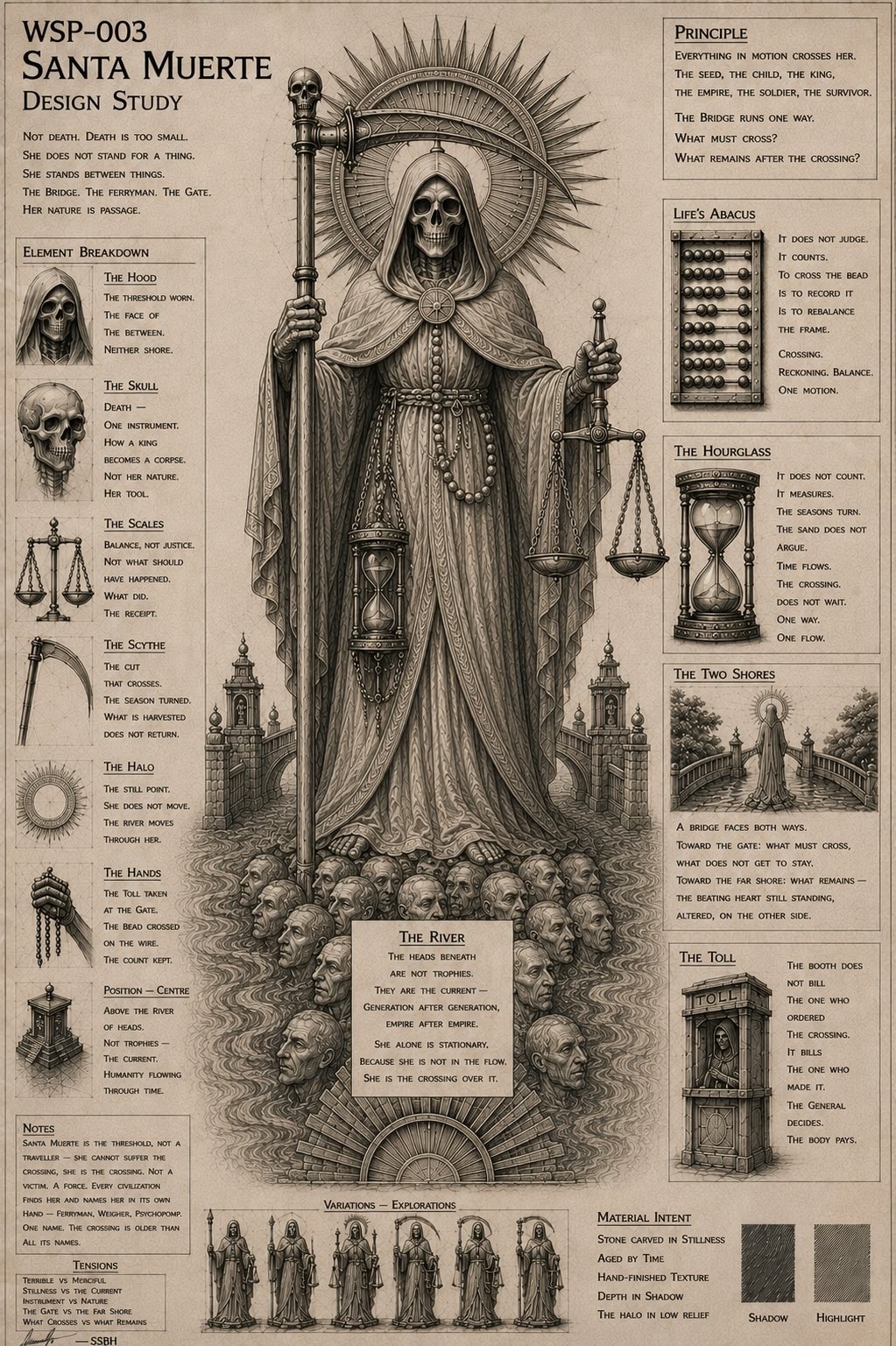
1. Foundational Statement
Not death. Death is too small.
She does not stand for a thing; she stands between things. The Bridge. The ferryman. The Gate. Death, the scythe, the scales are her instruments, not her nature. Her nature is passage.
The Bridge runs one way. What must cross? What remains after the crossing?
2. Placement & Hierarchy
The Santa Muerte occupies the centre of Panel One — the crossing point of its two axes, standing above the River. In the panel’s reading order, bottom to top, everything read before her rises toward her and everything read after her is seen through her. The panel rises from Horus; it passes through her. She presides not by rank but by position: there is no route across the composition that does not meet her hands.
Hierarchy: Presiding — the crossing every element must pass through. Status in the register: Element 07, Canonical.
Everything in motion crosses her.
The seed, the child, the king, the empire, the soldier, the survivor.
3. The Shared Axis — Her Grip
The defining structural decision of WSP-001 (Horus; legacy identifier WSP-002), read from the other side. The staff, the caduceus, and the scythe are not separate instruments — they are the same vertical axis revealed through different claims. Three hands close upon it: Horus’s hand closes upon truth, the Witness’s hand closes upon testimony, and Santa Muerte’s hand closes upon consequence.
The design study renders her end of that axis: at her grip the instrument shows as the scythe-staff — skull at the head, blade at the top. This is not a second object. It is the same vertical the herald’s rod occupies, seen from the end that collects. The rod announces; the blade crosses. The skull at its head names where broken covenants end (WSP-006, the Caduceus; legacy identifier WSP-001) — her territory, named on truth’s own instrument. She does not seize the staff from truth or from testimony. She holds the end of it that was always hers.
The rod announces. The blade crosses.
One instrument. Two directions.
4. The Scales — The Receipt
Balance, not justice. Her left hand holds the scales that corrupted Justice (Lady Justice / Medusa) also holds — but in her grip they weigh a different question. Justice asks what should have happened. She weighs only what did. The scales are not a verdict. They are the receipt.
This is why the weighing continues at the threshold whether or not the courts are honest. A corrupted court can revise the finding; it cannot revise the crossing. The staff is held by truth on one axis, the scales by power on the other, and her two hands bridge both — she is the only figure on the panel touching both instruments.
5. Element Breakdown
Element
Holds
Meaning
The Hood
The Threshold Worn
The threshold worn as a garment. The face of the between. Neither shore — she belongs to the crossing, not to either side of it.
The Skull
Death — One Instrument
How a king becomes a corpse. Not her nature: her tool. Death is one instrument among hers, and the smallest reading of what she is.
The Scales
Balance, Not Justice
Not what should have happened. What did. The receipt, not the verdict. Jointly held with corrupted Justice across the panel.
The Scythe
The Cut That Crosses
The season turned. What is harvested does not return. Her end of the shared axis — the blade and the herald’s rod are one vertical.
The Halo
The Still Point
She does not move. The river moves through her. The stillness is what qualifies her to measure the current. In low relief — see Production.
The Hands
The Toll Taken
Taken at the Gate. The bead crossed on the wire. The count kept. Not seizure — recording.
The Hourglass
The Measure
At her belt. It does not count, it measures. The seasons turn; the sand does not argue; the crossing does not wait. One way, one flow.
Life’s Abacus
The Reckoning
It does not judge. It counts. To cross the bead is to record it and to rebalance the frame. Crossing, reckoning, balance — one motion.
Position — Centre
Presiding
Above the River of heads. Not trophies — the current. Humanity flowing through time, and the one stationary point it flows past.
6. The Hourglass & the Abacus — Measure and Reckoning
Two instruments hang on the same doctrine and must not be collapsed into each other. The hourglass measures; the abacus counts — and the difference is the whole argument.
The hourglass does not count, it measures. A count can be argued with — appealed, adjusted, revised, falsified. Counting is what the machinery above her does: casualty figures, budgets, mandates, polls. Measure admits no revision. The seasons turn, the sand moves one way at one rate and finishes. The lie can rewrite every number on the panel except this one.
The abacus does not judge, it counts. Where the machinery’s counting is an argument, hers is a record. To cross the bead is to record the crossing and to rebalance the frame — the same motion does both. Nothing is added to the total and nothing is removed from it; the bead only changes which side it is on. Crossing, reckoning, balance: one motion. This is the panel’s answer to managed statistics — a ledger where recording and reckoning cannot be separated, and where no bead can be quietly taken off the wire.
7. The Two Shores — The Bridge Faces Both Ways
A bridge faces both ways. Toward the Gate: what must cross, and what does not get to stay. Toward the far shore: what remains — the beating heart still standing, altered, on the other side. Both readings are canonical, and the second is the one the foundation is named for.
This is where WSP-007 (legacy identifier WSP-003) stops being a document about death. The crossing has two outputs, not one. The Gate takes what cannot stay — that ledger is the headstones (Element 03). The far shore holds what remains — and what remains is not a memory but a person: altered, still standing, still beating. That is the wheelchairs (04) and the Empty Chair (15), and it is the young woman on Panel Two. Silent Scars, Beating Hearts is the far-shore reading of this element — the insistence that the bridge be read from both ends, because the side the institutions forget is the side where the survivors are standing.
8. The Toll — Who Is Billed
The booth does not bill the one who ordered the crossing.
It bills the one who made it.
The General decides. The body pays.
The toll is the oldest fact about the crossing and the sharpest indictment on the panel. Every tradition that has named this office has priced the passage — the obol under the tongue, the fare, the fee at the gate. The toll is ancient; only the currency changes. What the booth cannot do is redirect the invoice.
The decision and the payment are made by different people, and the machinery above her depends on that gap staying invisible. The order is issued in one room; the toll is collected from a body in another. Element 19 carves the justification into the perimeter; Element 11 supplies the paperwork. The booth is indifferent to all of it. It bills the one who made the crossing, every time, without appeal — which is why this element and not Justice is where the panel’s accounting actually happens.
9. The River — The Heads Are Not Trophies
Beneath her, the field of faces. The reading is explicit and load-bearing: the heads are not trophies. They are the current. Generation after generation, empire after empire — humanity in motion, flowing through time. She is not standing on the dead. She is standing over the flow.
She alone is stationary, because she is not in the flow. She is the crossing over it. Everything the panel produces is current: the dead, the living altered, the slogans, the seized instruments. Only what does not move with the river can measure the river. Heraclitus (Element 22) names the water; she is the bank it is named from.
10. The Still Point — Among the Witnesses
Four elements carry the witness spine of the WSP series, each holding one canonical question. The Caduceus is the Message — what remains true when narratives coil around reality? The Horus is Force — does imperfect sight invalidate rightful force? The Santa Muerte is the Crossing — the still point the river passes through.
Her question is the sheet’s own: what must cross, and what remains after the crossing? She is a force, not a sufferer — the doctrine is emphatic. She is the threshold, not a traveller. She cannot suffer the crossing; she is the crossing. Not a victim. Every civilisation finds her and names her in its own hand — Ferryman, Weigher, Psychopomp. One name under all of them. The crossing is older than all its names.
11. Relationship to the Governing Philosophy
Ubi Mendacium Regnat, Umbra Crescit — where lies reign, shadows grow. Her relationship to the lie is unrequited: she does not serve it, but it feeds her queue. The machinery manufactures crossings — it sends the young to the threshold early, ahead of every honest schedule, and then bills the body rather than the room the order came from.
Where Horus is the panel’s answer, she is its audit. She keeps the one record the lie cannot edit: everything the apparatus produces crosses her, and the crossing is recorded without narrative. The crossing does not read the graffiti. The current edition of the lie is carved into the perimeter; the sand runs and the bead crosses regardless of what the perimeter says this year.
12. The Inheritance & the Living Claim
She is the youngest face of one of the oldest offices humanity has staffed. In Mictlan, the underworld of the Mexica, the dead travelled four years through nine levels to reach Mictlantecuhtli and Mictecacihuatl, the Lady of the Dead — a journey, not a sentence. That is the oldest reading of the office: death as crossing rather than ending. Across the ocean the same office wore a different face — the skeletal figure with the scythe on the plague roads of medieval Europe, the Fates measuring thread, the ferryman taking the obol at the river. When the two traditions collided in New Spain, the office survived the collision; offices this old survive every administration. Every civilisation finds her and names her in its own hand.
Inquisition records from the late eighteenth century already describe devotion to a skeletal “Santa Muerte” — suppressed, driven into home altars, never extinguished. For two centuries she lived privately. On the eve of All Saints, 2001, Enriqueta Romero set her figure in a street-front shrine in Tepito, Mexico City, and the private devotion became public. She is now among the fastest-growing devotions in the Americas — and her devotees are overwhelmingly the people the institutions abandoned: the poor, the imprisoned, the night workers, the ones no official saint would take. This is load-bearing for the panel: the crossing does not check credentials. She was never canonised because she was never any institution’s to canonise.
The claim is not only ancient; it is present, and it is the bridge to Panel Two — literally, in this element. The young woman on the hospital bed reached the Gate and was not taken. She stands on the far shore: altered, still standing, the beating heart on the other side. The toll was collected from her and not from the room the order came from — the revoked function the Empty Chair holds (SSBH-CHAIR-001), the permanent renegotiation the wheelchairs name. In this doctrine a survivor is not someone death missed. A survivor is what remains after the crossing. SSBH’s work is with the far shore: the insistence that the crossing be measured and reckoned, not narrated — recorded at the threshold, where the beads cannot be taken off the wire.
13. Tensions Held
Terrible vs merciful · Stillness vs the current · Instrument vs nature · The Gate vs the far shore · What crosses vs what remains.
14. Production & Status
Material intent: stone carved in stillness, aged by time; hand-finished texture; depth in shadow; the halo in low relief. Sculptural state: clay relief advanced, Sherwood Park studio — figure resolved with halo, staff, scales and hourglass; the River, the Two Shores, the Toll booth and the Abacus resolved at design and pending in clay (studio record, June–August 2026). Design study: resolved (legacy WSP-003 sheet, now WSP-007, SSBH, 08.08.2026) — see Appendix. Register status: Presiding element, Panel One Element 07 — resolved at doctrine and design; sculptural execution ongoing.
Appendix — The Design Study Sheet
Legacy identifier: WSP-003 · Current canonical identifier: WSP-007 · The Santa Muerte · Design Study · SSBH · 08.08.2026
Ruling note (August 2026): Santa Muerte’s canonical office is the Crossing, under Canonical v1.0. This page was exported from the v1.2 working draft, which is retained on record and was not adopted; it will be re-exported from v1.0. Source: WSP-007 The Santa Muerte Canonical v1.2 working draft (August 2026) · SSBH doctrine register. Do not edit here — edit the canonical document and re-export.