WSP-001 · Force
Horus
What must be met, held, or struck — and at what cost to the one who acts.
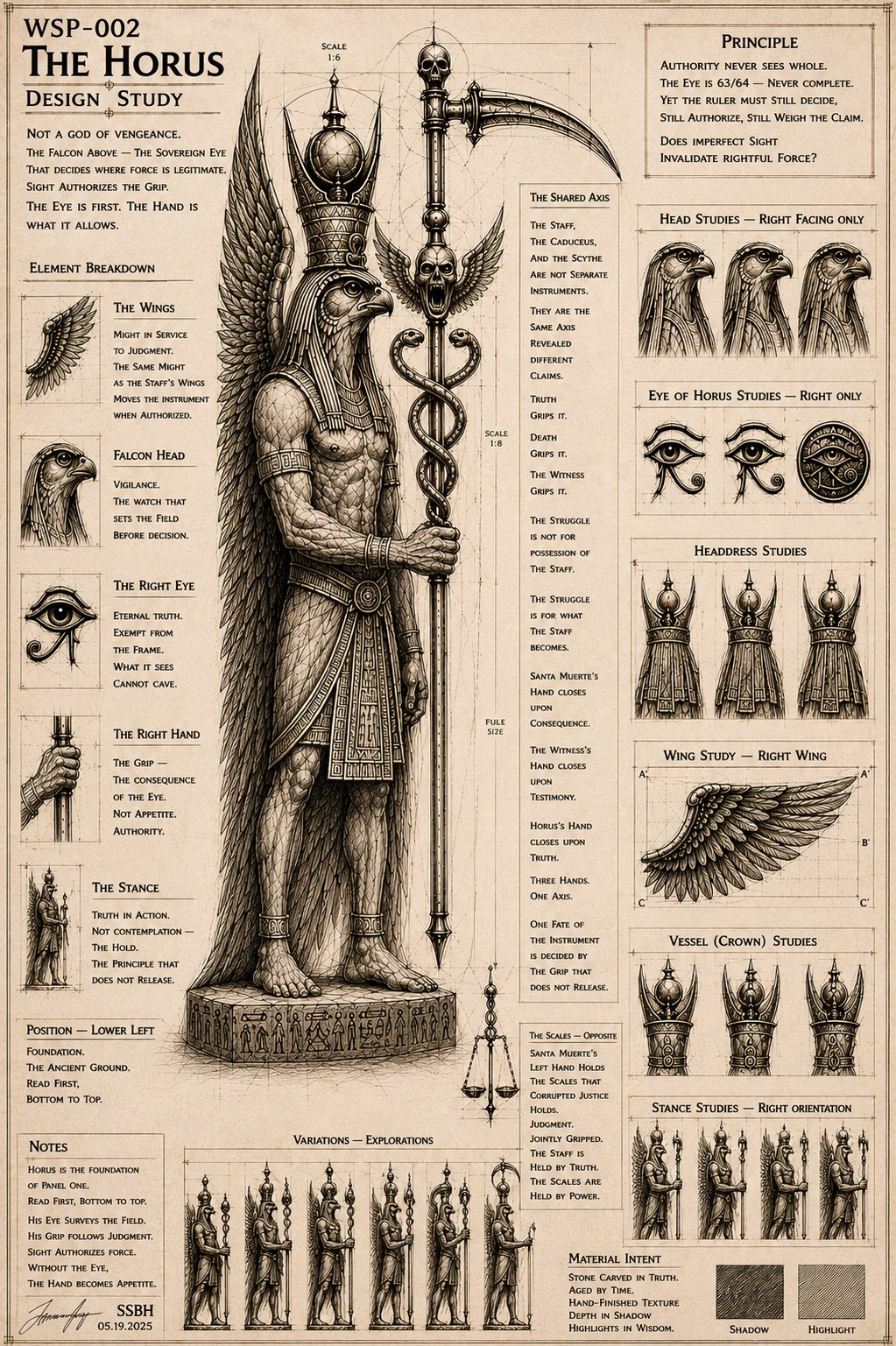
1. Foundational Statement
Not a god of vengeance.
The Horus is the principle that force must answer to truth. The son rises after the desecration — not to avenge the father, but to restore the order the murder broke. Force without legitimacy is only appetite.
Order is not seized. It is earned by rising.
2. Placement & Hierarchy
Horus occupies the lower left of Panel One — the ancient ground. In the panel's reading order, bottom to top, he is read first. He is the foundation: truth in action within time, the societal principle that just war must answer to truth. The panel rises from him.
Hierarchy: Foundation — truth in action within time. Status in the register: Element 01.
3. The Shared Axis
The defining structural decision of WSP-001. The staff, the caduceus, and the scythe are not separate instruments — they are the same vertical axis revealed through different claims. Three hands close upon it:
Horus's hand closes upon truth. Santa Muerte's hand closes upon consequence. The Witness's hand closes upon testimony. The struggle is not for possession of the staff. The struggle is for what the staff becomes. The fate of the instrument is decided by the grip that does not release.
Truth grips it. Death grips it. The witness grips it.
Three hands. One axis.
4. The Scales — Opposite
Across the panel from the shared staff: Santa Muerte's left hand holds the scales that corrupted Justice (Lady Justice / Medusa) holds. Judgement, jointly gripped. The composition stages a balance — the staff held by truth on one axis, the scales held by power on the other, with Santa Muerte's two hands bridging both.
The staff is held by truth. The scales are held by power. This opposition is the panel's central question made physical.
5. Element Breakdown
Element
Holds
Meaning
The Wings
Might
The same might as the staff's wings. The force that moves the instrument. Not acceleration — strength.
Falcon Head
Vigilance
The watch that does not close. Sight above the field.
The Left Eye
Eternal Truth
Exempt from the frame. The temporal lie is carved into the perimeter; this eye is not. What the lie cannot carve.
The Right Eye
Truth in Time
Sight within the world. The cost of seeing clearly.
The Double Crown
Legitimacy
The pschent — white crown within red, Upper and Lower land unified. Rule over the whole, worn by right, not seized. A crown is worn; a vessel is filled. This form holds both.
The Hands
The Grip
Closed on the shared staff. Truth's claim on the instrument. The principle that does not release.
The Stance
Truth in Action
Not contemplation — the hold. The principle that enters time and does not let go.
Position — Lower Left
Foundation
The ancient ground. Read first, bottom to top.
6. The Crown and the Vessel
The headdress is the pschent, the Double Crown of ancient Egypt — the white hedjet of Upper Egypt seated within the red deshret of Lower Egypt. On a falcon-headed figure it is Horus's claim to unified, legitimate kingship over the whole land: authority held by right, not seized.
The form deliberately holds an ambiguity. A crown is worn by right; a vessel is filled and poured. The slippage between what rules and what holds is the panel's theme rendered in a single form — kept intentionally, not resolved away.
7. The Two Eyes
The Left Eye is eternal truth — exempt from the perimeter frame. The frame of Panel One carries the temporal markers, the current edition of the lie carved into its stone. The left eye of Horus is the one element of the composition exempt from that frame: it represents eternal truth, not the temporal. This is canonical and load-bearing.
The Right Eye is truth in time — sight within the world, and the cost of seeing clearly. Together the two eyes hold the doctrine: truth that the lie cannot carve, and truth that must be paid for to keep.
8. The Wings — Might
The wings are deliberate and they connect to the Caduceus's wings as the same might — the force that moves the instrument. Where a lesser reading would make wings mere acceleration or flight, here they are strength itself: the power that makes the staff move and the grip hold. Horus's wings and the staff's wings are one force, named across both WSP-006 and WSP-001.
9. Relationship to the Governing Philosophy
Ubi Mendacium Regnat, Umbra Crescit — where lies reign, shadows grow. Horus is the answer the panel offers to its own accusation: the principle that the lie must finally answer to truth. He is truth in action within time — not the eternal witness above (that is the Eye of Providence and the Sun), but truth that enters the world and grips the instrument. Without his hold, force becomes appetite and war answers to no one.
10. The Inheritance & the Living Claim
Horus is among the oldest attested figures in human civilisation, and his record is the record of legitimacy earned rather than inherited. Falcon motifs appear on pottery from Naqada II, circa 3500 BCE, at Hierakonpolis — the city of the falcon. The serekh, the earliest royal cartouche, sets the falcon atop the king’s name: before there was a unified Egypt, the falcon already watched from above. The myth is unsparing. Osiris, the legitimate order, is murdered and dismembered by Set, the god of chaos. Horus is conceived in the aftermath, born in hiding, and contends for the throne across what some accounts give as eighty years of tribunal — a long, costly, often unfair process. He is not handed the throne. He earns it. This is the foundation’s meaning: order is not seized, it is earned by rising.
The Wedjat — the restored Eye — carries the arithmetic of that cost. Torn out by Set and restored by Thoth, its six parts sum to 63/64; the missing sixty-fourth is what is restored through understanding, never quite whole. The right to see in human affairs is never untouched. When the eye is restored it does not signify innocence — it signifies recovered legitimacy: the right to see and still act. This is the same doctrine the Two Eyes carry in Section 7, told from the side of what it cost to keep them.
The claim is not only ancient; it is present, and it is the bridge to Panel Two. The young woman on the hospital bed did not enter conflict willingly — the conflict entered her. What she embodies is the Horus principle at the individual scale: the damaged sight, the irreplaceable loss, the long and unfair work of remaining present, the refusal to be erased from the record. Horus at the societal scale is what SSBH itself does — naming the violation, placing her at full scale in public space, insisting the cost be witnessed rather than managed off the record. The Wedjat restored, the right to see recovered, the claim resumed. He grips the shared staff (Section 3) because truth’s claim on the instrument is the precondition of her claim being heard at all.
11. Tensions Held
Order vs chaos · Legitimacy vs appetite · The rightful claim vs the usurpation · Truth's grip vs death's grip vs the witness's hold.
12. Production & Status
Material intent: stone carved in truth, aged by time; hand-finished texture; depth in shadow, highlight in wisdom. Sculptural state: clay relief in progress, Sherwood Park studio; the figure resolved to a standing, two-handed grip on the shared staff after pose exploration (recorded in the design study's Variations strip). Design study: resolved (legacy WSP-002 sheet, now WSP-001, SSBH, 05.19.2025). Register status: Foundation element, Panel One Element 01 — resolved at doctrine and design; sculptural execution ongoing.
Appendix — The Design Study Sheet
Legacy identifier: WSP-002 · Current canonical identifier: WSP-001 · The Horus · Design Study · SSBH · 05.19.2025