WSP-006 · Message
Caduceus
What must be carried, and told truthfully, before anything can be acted on.
1. The Declaration
Truth is not owned. Truth is served.
The Caduceus is the herald's staff — the instrument that carries word between powers and between worlds. It is not a medical emblem and not a brand. It is the place in the work where truth must move, and where movement is the danger: every messenger has an interest, every passage is a chance to distort. The Caduceus is the integrity of the message under those conditions.
2. The Canonical Question
Each witness is bound to a question. The Chair asks what has happened to the one who no longer fits the life that once fit her. Horus asks whether imperfect sight invalidates rightful force. The Caduceus asks the question of transmission itself:
What remains true when narratives coil around reality?
This is the question of every message that must pass through hands that have interests. The twin serpents are the narratives that coil around the real. The staff is the thin vertical of fact they wind around. The question is whether anything reaches the other end uncorrupted — and if so, what.
3. Transit — Truth Distorted in Movement
In the Panel One hierarchy the Caduceus sits at Transit: the zone where truth is altered as it moves. Not where truth is born and not where it is finally judged — where it travels, and is changed by travelling. The herald carries the message from one power to another, from one world to the next, and in the carrying it is brokered, softened, sharpened, spun. This is the broken covenant of negotiation: the promise that the message will arrive as it was sent, and the near-certainty that it will not.
The Caduceus names the mechanism by which Ubi Mendacium Regnat operates. The lie does not reign by being believed outright. It reigns by controlling transmission — by managing what is carried, what is omitted, what is coiled around the fact until the fact can no longer be found. Wherever truth must move through interested hands, the Caduceus stands.
4. The Coiling — The Twin Serpents
Two serpents wind around the staff. They are not decoration and they are not medicine. They are the narratives that coil around reality — the competing accounts, the framings, the spin that wraps itself around the thin vertical of what actually happened until the vertical is hidden inside the coil.
The serpents are not simply evil. A narrative is how meaning travels; without some coil, the bare fact cannot move through human minds at all. The danger is not that narrative exists — it is that narrative can grow until it replaces the thing it was meant to carry. The Caduceus holds the tension: the staff still stands inside the coil. The fact is still there, wound around but not yet erased. The question is how tightly the serpents may wind before the truth they carry is strangled.
5. The Scream — The Instrument Becoming Honest
At the head of the staff is a screaming face. This is the load-bearing image of the Caduceus, and it is the answer to its own question.
The screaming face is the instrument becoming honest — the moment the carrier of the message can no longer keep its composure. The herald is trained to deliver the message smoothly, diplomatically, with the surface intact. The scream is the surface failing: the truth breaking through the composed face of transmission because it can no longer be contained. It is what survives the coiling. However tightly the serpents wind, however managed the delivery, something screams through that cannot be brokered away.
What remains true when narratives coil around reality? The scream. The thing that breaks composure. The truth the carrier can no longer keep.
6. Between Worlds — The Herald's Office
The Caduceus is classically the staff of the messenger who moves between realms — the living and the dead, the divine and the human, one sovereign power and another. In this work it carries what is altered between worlds: the message that must cross a boundary, and is changed by the crossing.
This is why the Caduceus sits between the foundation and the apex of the panel — at Transit, the middle, the passage. Below it, Horus authorizes force in the human realm. Above it, the eternal witness sees beyond time. The Caduceus is the vertical traffic between them: the channel through which truth must pass, and the place where the lie installs its tolls.
7. Among the Witnesses — Message, Force, Cost
The three resolved witnesses divide the territory cleanly, and the Caduceus must not be confused with the others:
Element
Territory
Question
The Caduceus
The integrity of the message
What remains true when narratives coil around reality?
Horus
The legitimacy of force
Does imperfect sight invalidate rightful force?
The Chair
The cost borne by the one
What has happened to me that I no longer fit the life that once fit me?
Message, force, cost. The Caduceus is the first because everything else depends on whether truth can move at all. If the message cannot survive transmission, force cannot be judged and cost cannot be witnessed. The Caduceus is the precondition of the others — which is why it sits at Transit, holding the channel open.
8. Relationship to the Governing Philosophy
Ubi Mendacium Regnat, Umbra Crescit — where lies reign, the shadow grows. This is the Caduceus's own sentence more than any other element's. The lie's reign is precisely a reign over transmission: control the message, coil the narrative, manage the record, and the shadow grows in the gap between what happened and what is carried forward. The Caduceus is the refusal of that reign — not by owning the truth, but by serving it: by keeping the staff standing inside the coil, and by letting the scream break through when composure would bury it.
To meet the truth that screams through is to halt the lie's creation of the record. That is the Caduceus's function and its closing charge.
9. The Inheritance — Where the Staff Comes From
The staff is older than Greece, and its whole history is the history of a message moving through interested hands. Its earliest known form appears on Sumerian cylinder seals from 3000–4000 BCE — the entwined serpent staff of Ningishzida, messenger of the Earth Mother. It passed through Phoenician, Assyrian, Minoan, and Egyptian iconography before arriving in Greece as the kerykeion, the herald’s staff of Hermes. From the beginning it marked the one who carries word between powers — the office of transmission itself.
The meaning was fixed by exchange, not accident: Hermes gave Apollo the lyre he had invented; Apollo gave Hermes the golden staff in return. The symbol of negotiation was itself born from a negotiation. And the origin myth of the serpents states the function plainly — Hermes found two serpents locked in combat, set his staff between them, and they wound around the rod and held still. The staff is the thin vertical that stands between contending forces while their narratives coil around it. That is the same image the Panel carries forward: the fact at the centre, the coil winding tighter, the question of what survives.
Rome made the office explicit. The caduceator was the envoy who negotiated under the protection of the staff he carried; the staff granted safe passage and made its bearer inviolable. Augustus put it on imperial coinage beside the goddess Pax — the message of negotiated stability, carried by the authority of the staff. Across every one of these inheritances the constant is not medicine and not commerce as such. It is transmission: a message crossing a boundary under an authority that vouches for it.
The most instructive inheritance is the modern error. The caduceus is not, and never was, a medical symbol; the true symbol of medicine is the single-snake Rod of Asclepius. Its place on American medical insignia dates to a 1902 administrative mistake by an Army officer who believed foreign medical corps used it. The Surgeon General first rejected it; his successor approved it; the error became the standard and has held for over a century. This is the canonical question demonstrated in the historical record: a narrative coiled around the real until the real was lost, and the coil — not the fact — is what travelled. The staff has carried a meaning it does not own for a hundred years. What remains true under that coiling is exactly what the Caduceus is built to ask.
10. The Sculpture — What You Are Looking At
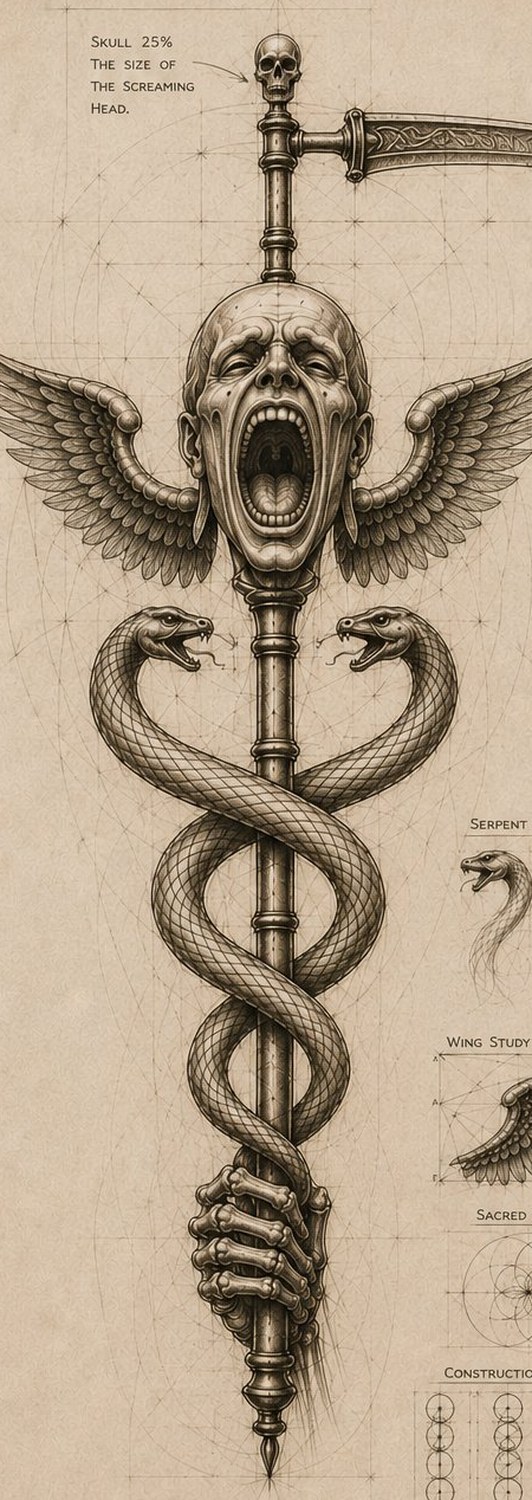
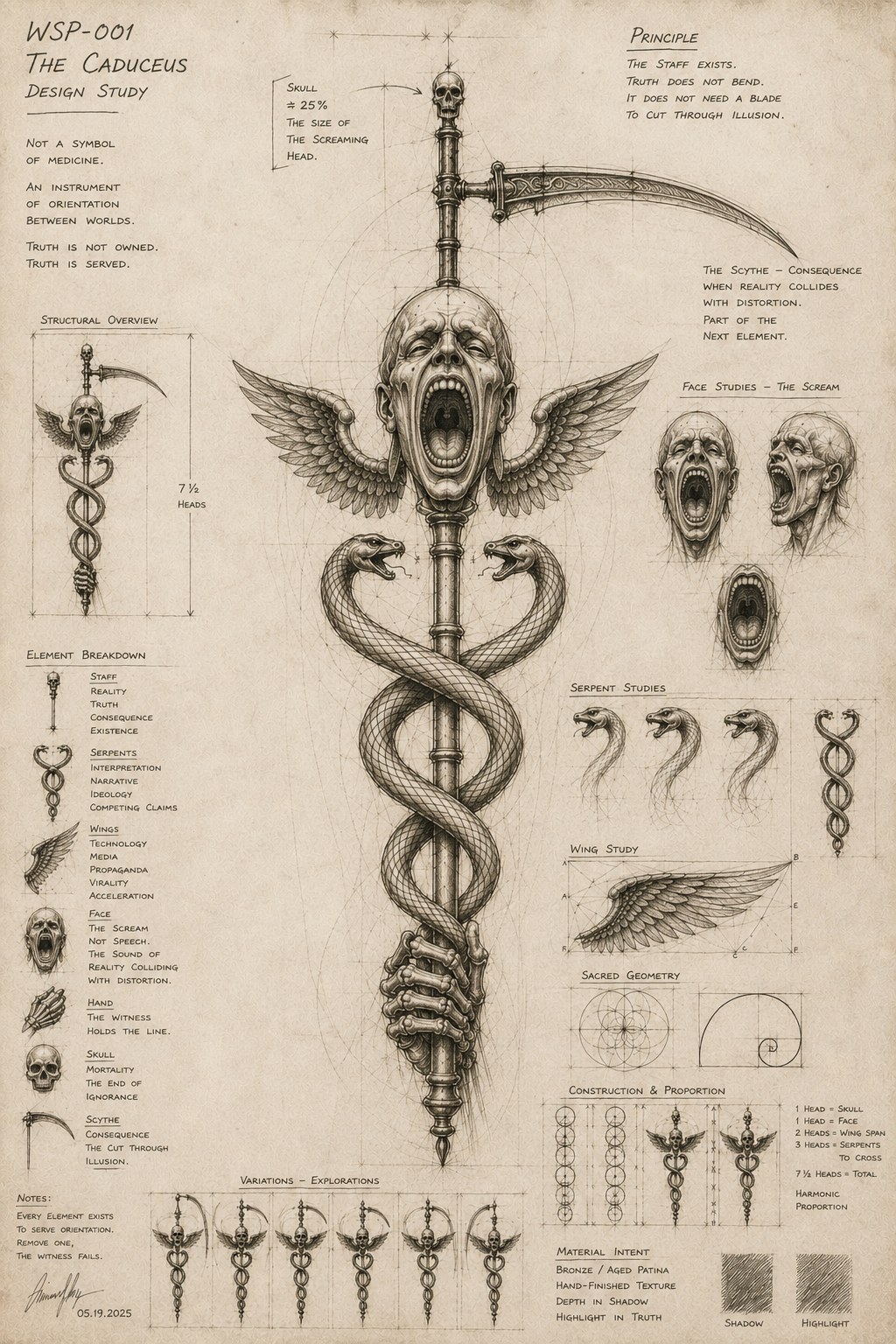
Every proportion is reasoned. The skull finial is one quarter the size of the screaming head. The wingspan is two heads. The serpents cross at three heads. The screaming face on the staff is not a figure of speech — it is the instrument becoming honest, carved at the moment the carrier of the message can no longer keep its composure. The wings are the herald's office; the staff is the thin vertical of fact; the serpents are the coil; the scream is what survives.
11. Element Status
Register
Status
Element
WSP-006 — The Caduceus · Legacy identifier: WSP-001
Nature
The integrity of the message in transmission. A witness, not a victim
Position on Panel
Transit — the middle passage, between Horus (foundation) and the Eye (apex)
Canonical Question
What remains true when narratives coil around reality?
The Coil
Twin serpents — the narratives that wind around the real
The Answer
The scream — the instrument becoming honest, what survives the coiling
Relationship to Victim
A force acting on the human cost. Carries whether her truth can move at all. Never the victim
Status in Clay
Present — resolved in design
12. Closing Invocation
The serpents coil. The staff still stands inside them.
The message is brokered, softened, managed, spun — and still, at the head of the staff, something screams through that cannot be carried away. That scream is what remains true.
What remains true when narratives coil around reality?
The Caduceus answers: the scream. To meet it is to halt the lie's creation of the record.
Appendix — The Design Study Sheet
Legacy identifier: WSP-001 · Current canonical identifier: WSP-006 · The Caduceus · Design Study · SSBH · 05.19.2025